INTRODUCTION
LIST OF CONTENTS
REVIEWS
PREFACE
RENOVATING YOUR HILL HARPSICHORD
LIST OF YOUTUBE VIDEOS FEATURING HILL INSTRUMENTS
VIDEOS
PREFACE
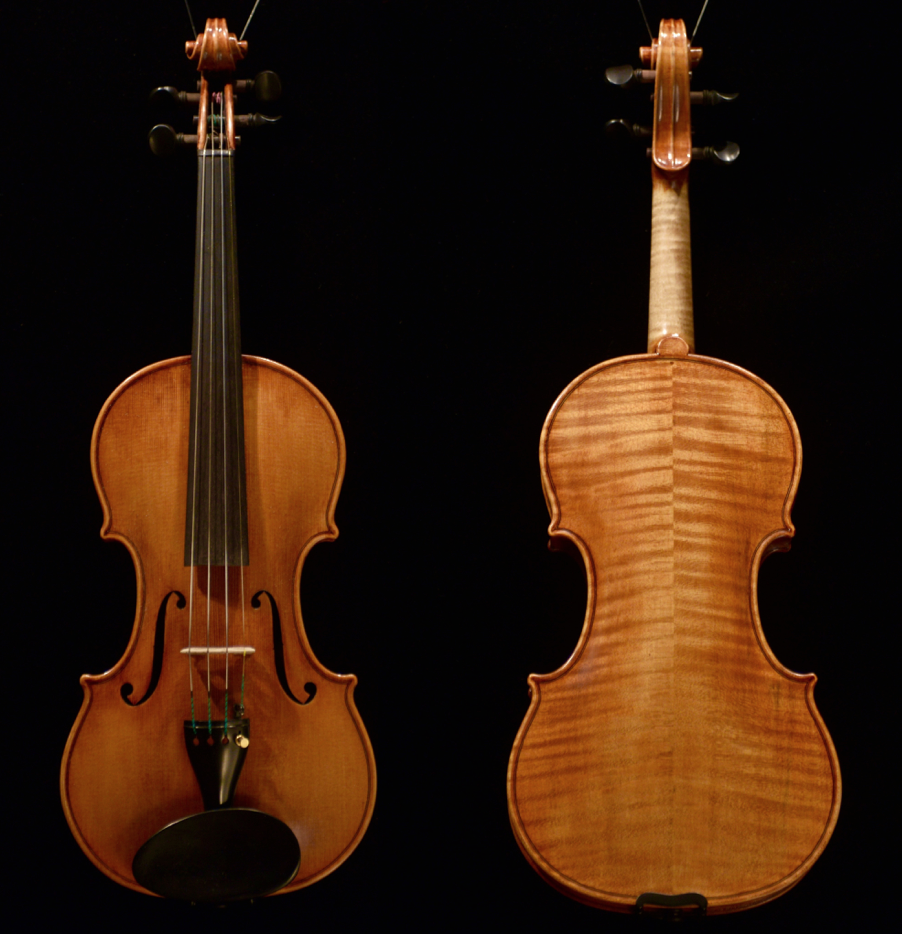
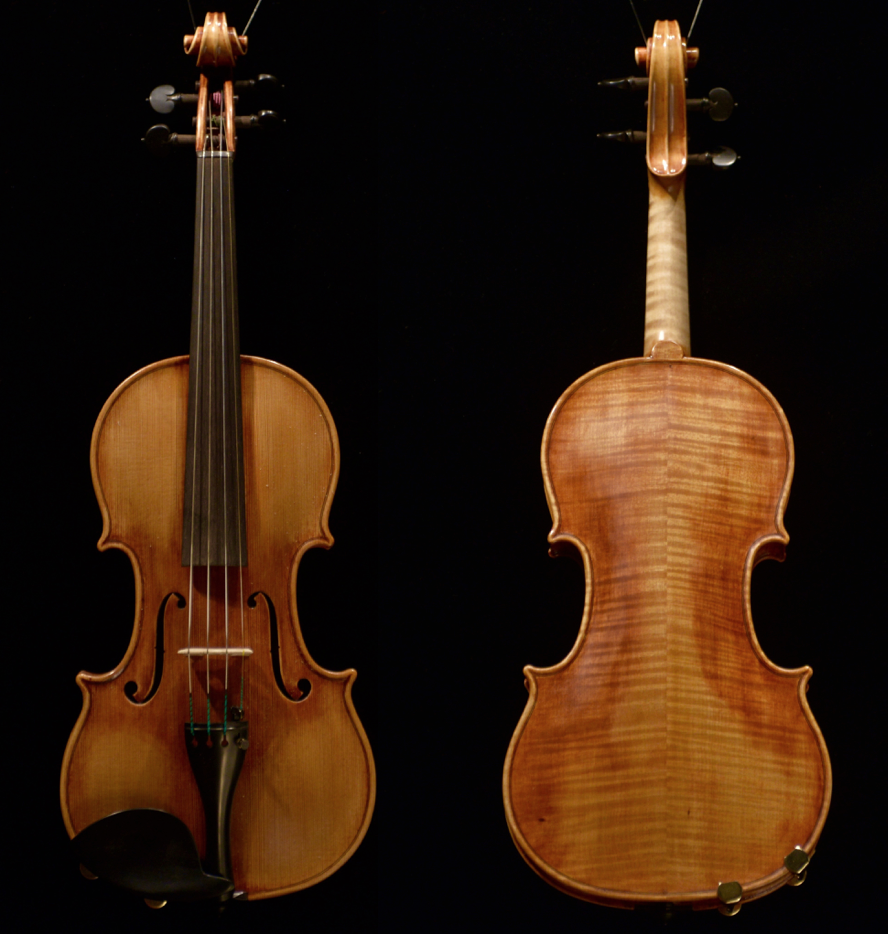
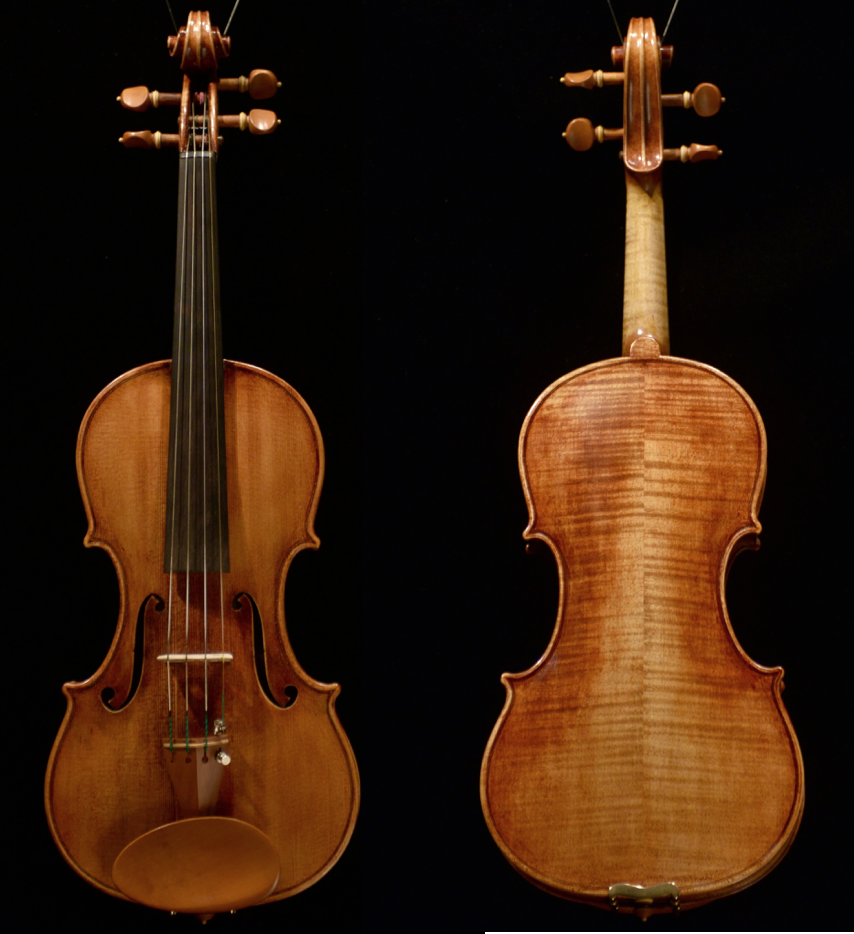
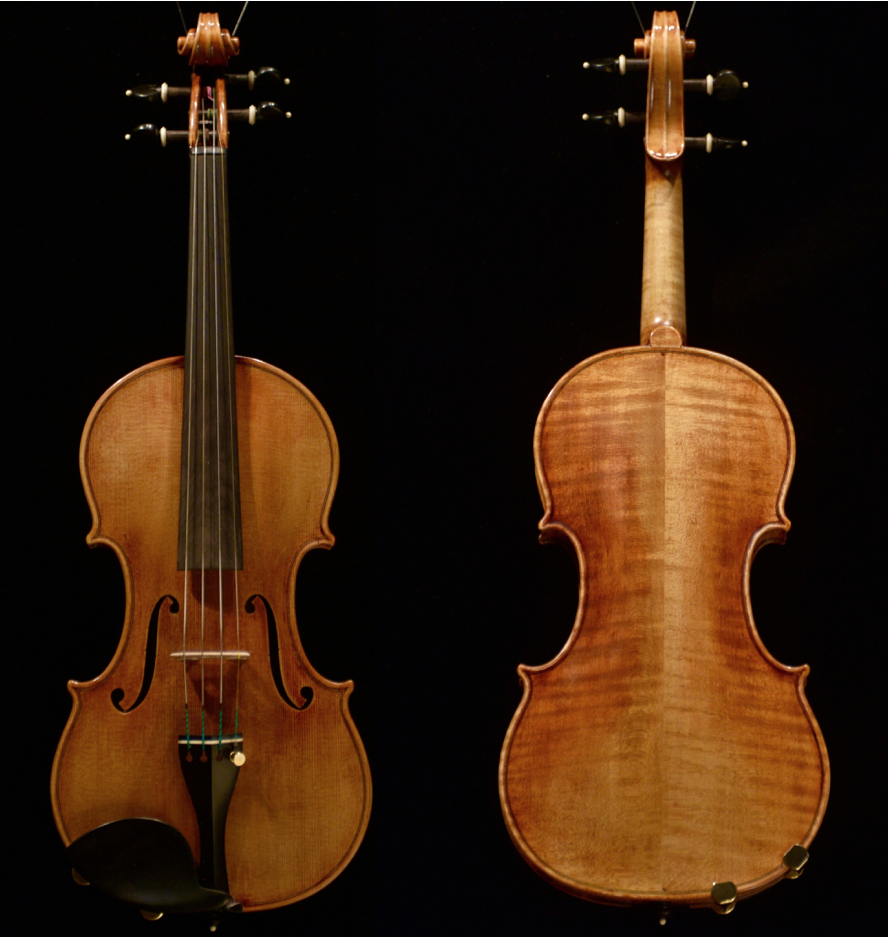
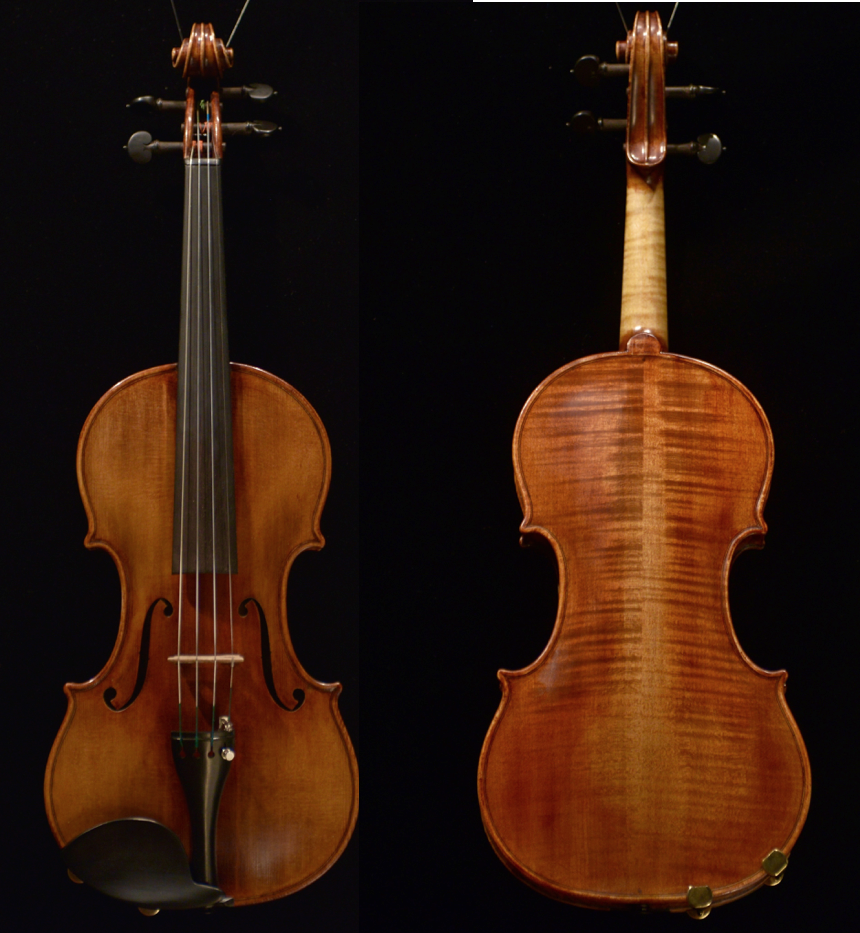
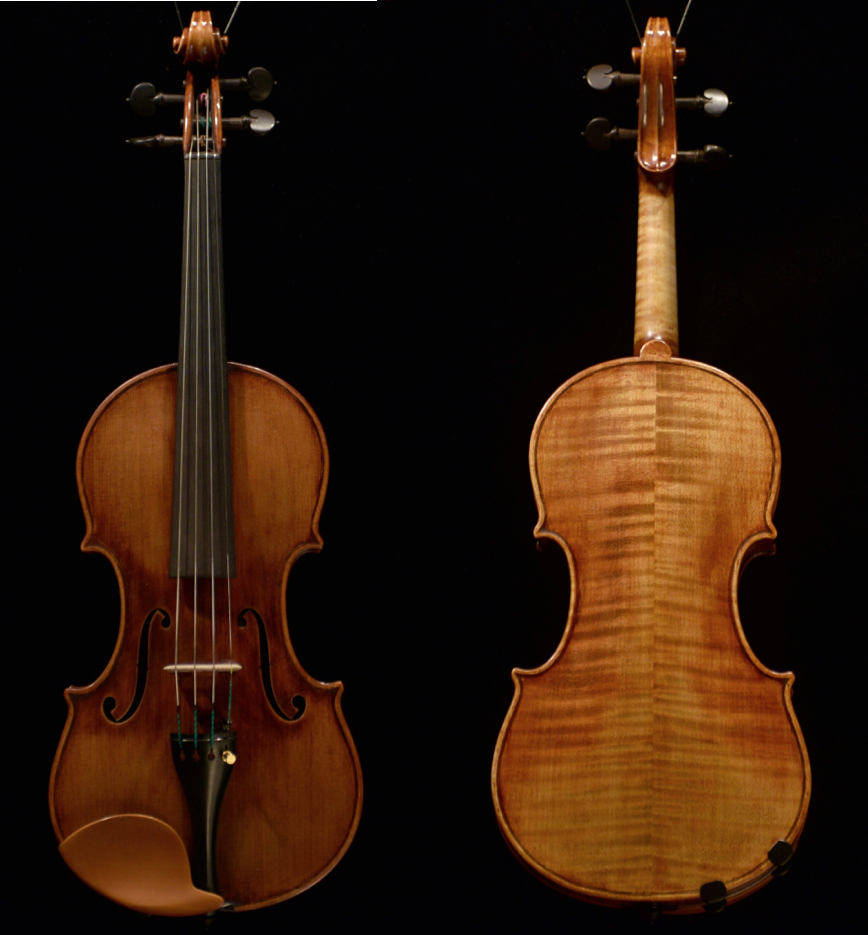
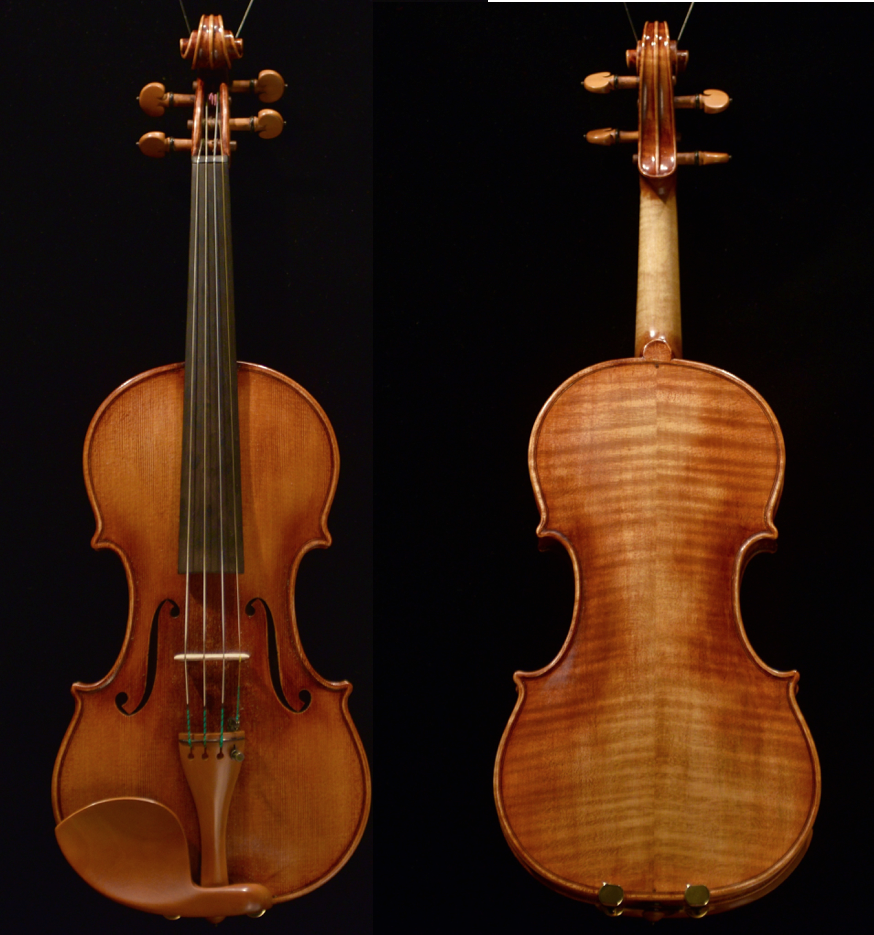
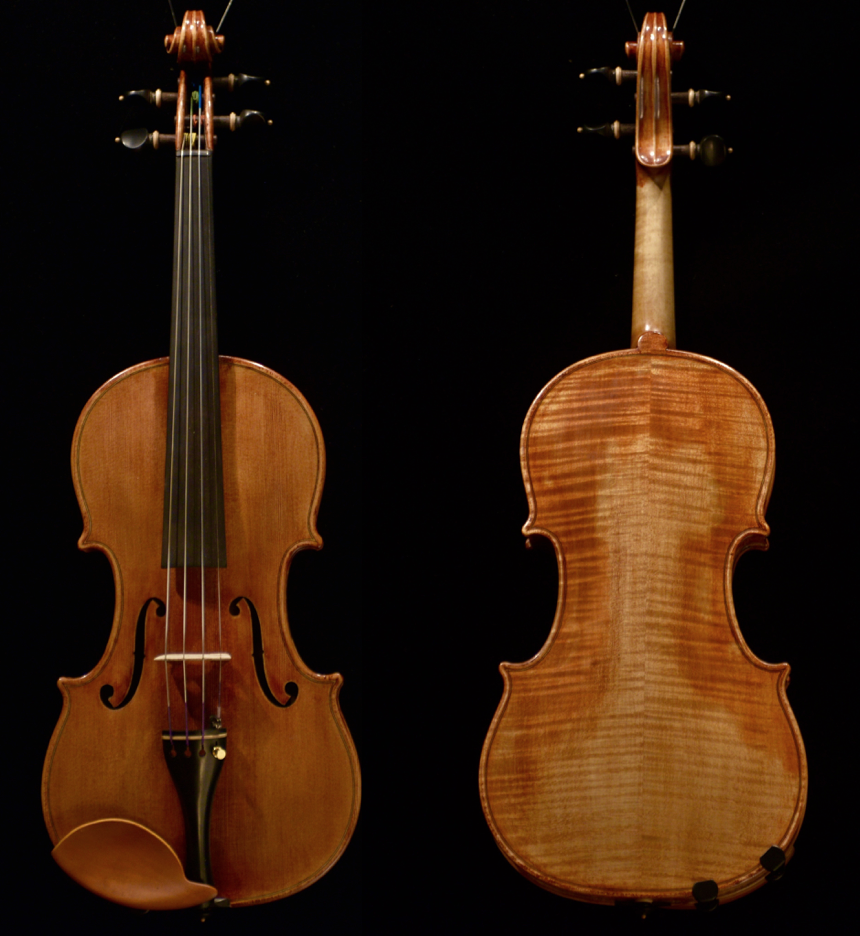
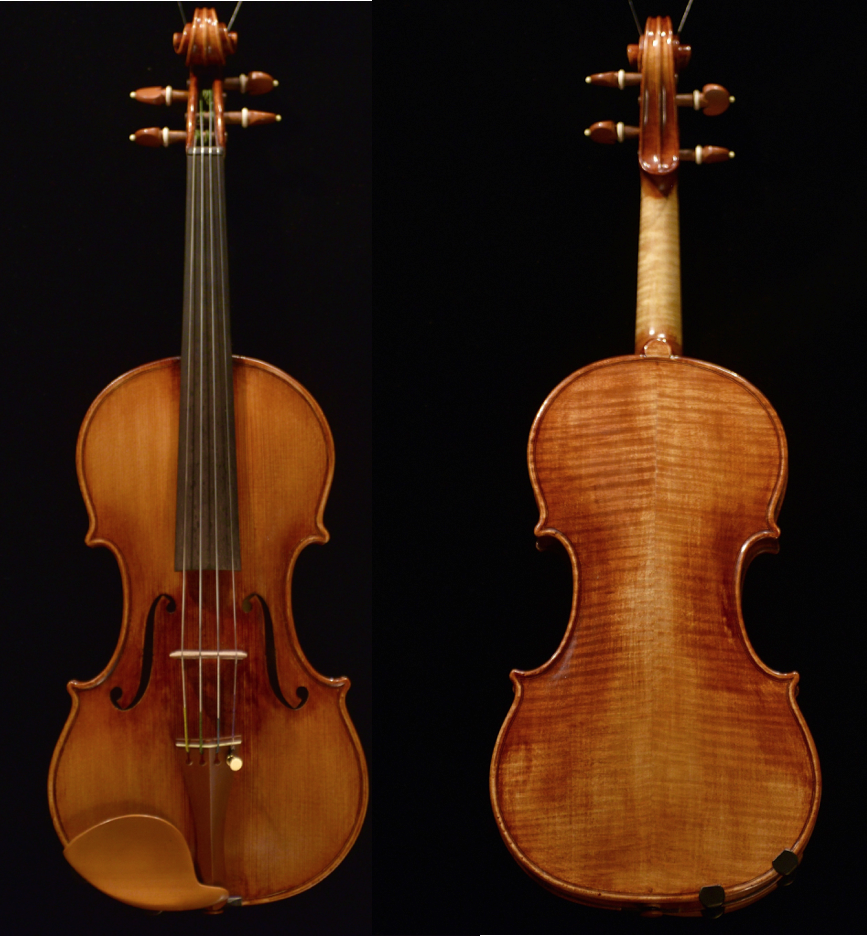
What follows is a recording of my violin Opus 504 in a Brahms Sonata in G Maj. played by Matthew Lammers for his DMA recital at Rice University. The acoustics of the hall leaves much to be desired I suspect because of the shell intended to improve the acoustics just sequesters the sound coming from the instruments.
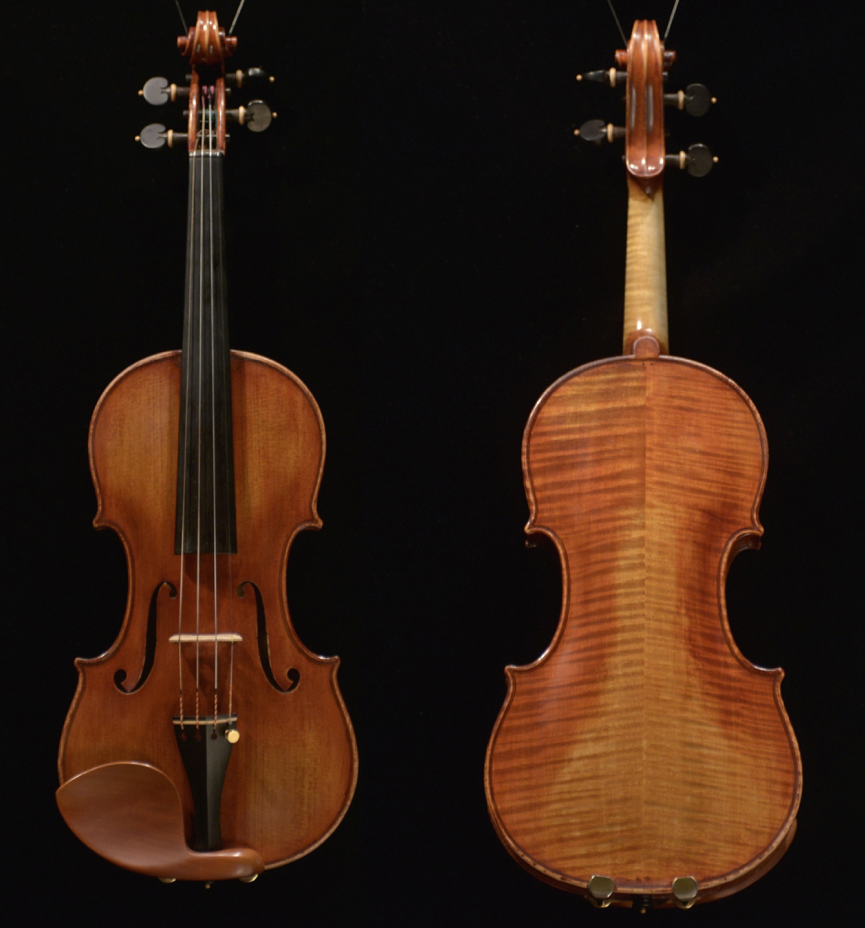
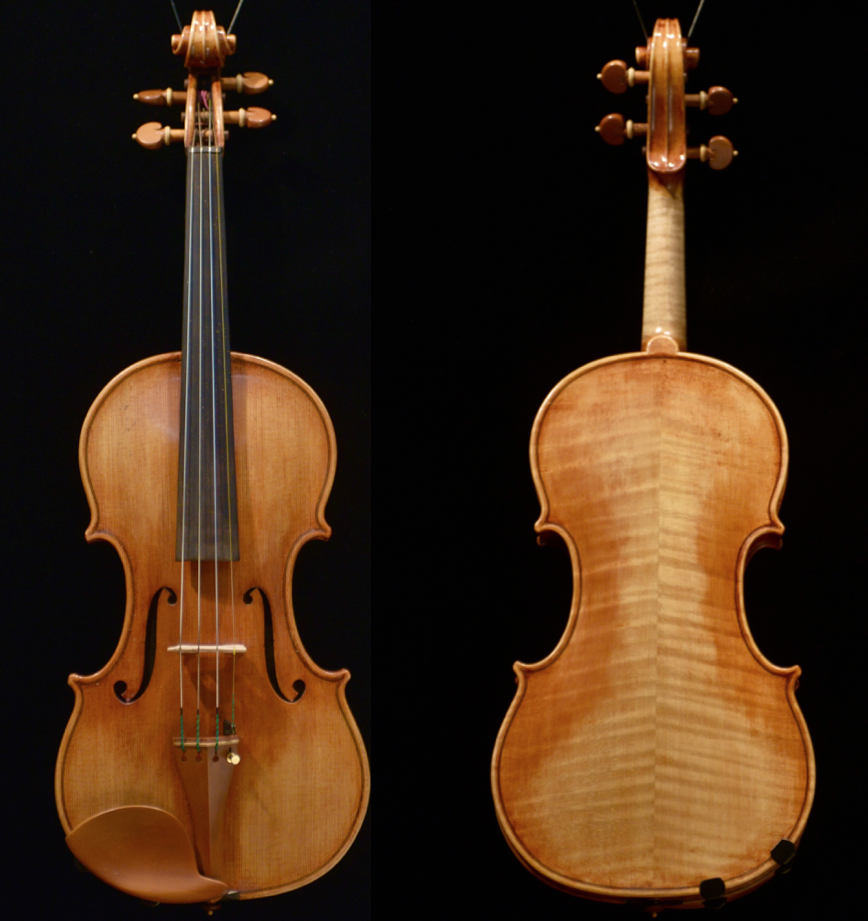
Here are recordings of two violins, my Opus 504 and Opus 518, recorded by Matthew Lammers in my violin shop on July 15th, 2019 using a Zoom recorder.
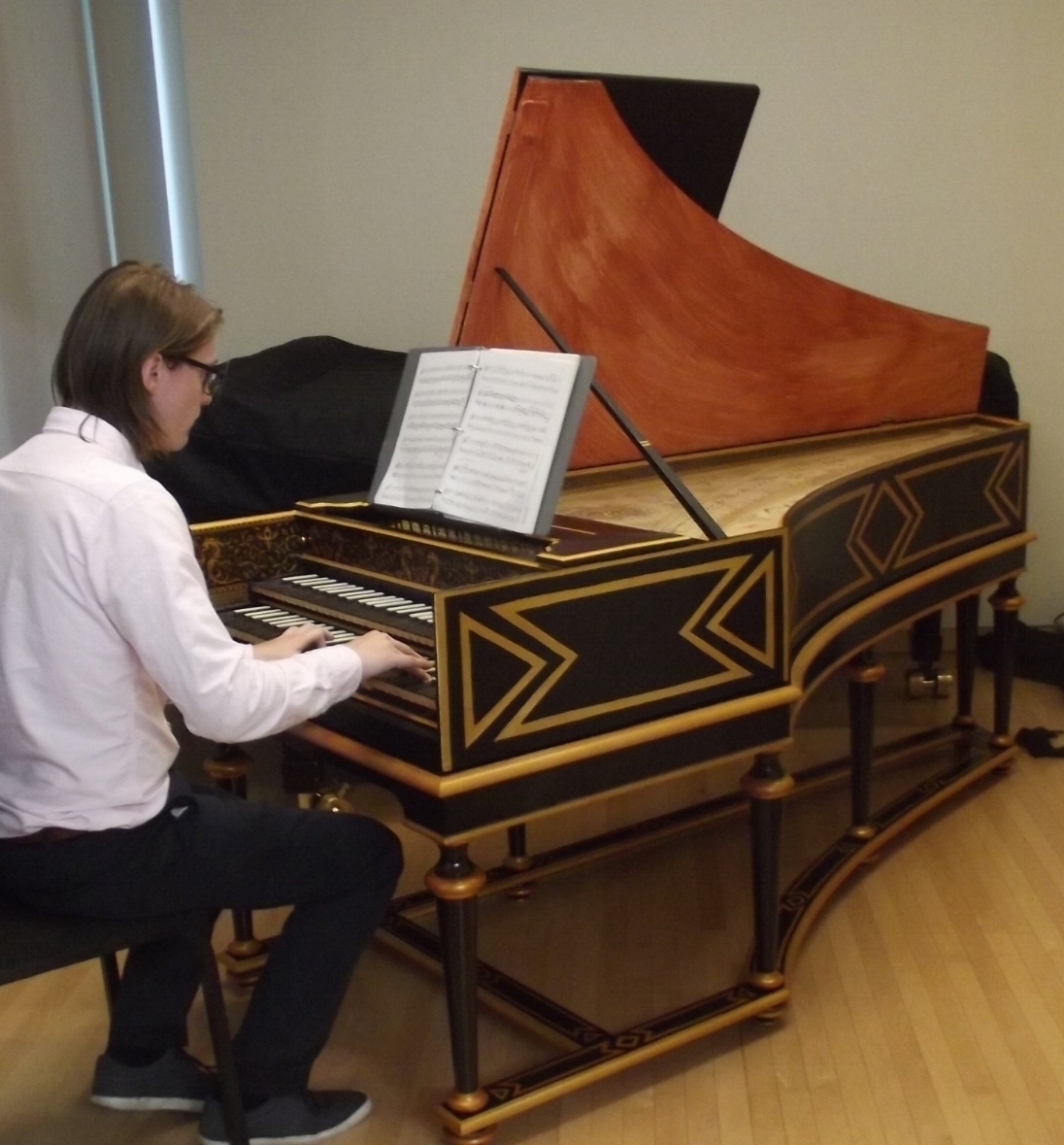
The recording offered below was recorded live by Professor of Harpsichord, Mark Edwards, at Fairchild Chapel in Oberlin, Ohio on September 27th, 2016 on my harpsichord, a copy of the 1624 Ruckers harpsichord in Colmar, France. I made the instrument in April of 2016 and finished the instrument in September. The photo below is of Prof. Edwards preparing for the concert on that harpsichord when the instrument was in the conservatory building the afternoon of the concert. This instrument is presently for sale.
REVIEWS
of Hill instruments by harpsichordist Elizabeth Farr
Old Musical Instruments & Modern Reproductions!
March 15, 2009
STEPHEN - Could you tell us about some of the unusual keyboard instruments that you play? Why you like them? How important is choosing the right instrument for the repertoire? We've come a long way from Wanda Landowska's six-cylinder hyper-harpsichords—what choices does a contemporary performer have to make when choosing an instrument? Are there any instrument-makers whose work you particularly admire?
ELIZABETH - My answer to this question centers on Keith Hill. While I am perfectly happy to play lots of different harpsichords, when the choice has been mine it has repeatedly been for harpsichords built by Keith Hill. His instruments are resonant, acoustically well structured, and capable of real expression. And to me, in the most tactile sense, the feeling of playing them coupled to the sound I hear is magical. Just as with any instrument, the player contributes to the quality of the sound but cannot solely create it. Choosing specific harpsichords for each of my recordings is something I have routinely consulted on with Keith. But while we decide to use a certain harpsichord because it will suit the requirements of a particular repertoire, I think listeners will simply appreciate that it is a good sound and that the music can speak with integrity to them via the sound. That’s all that really counts.
As to the unusual nature of these instruments, for listeners the two that most qualify for this distinction are the lute-harpsichord and the harpsichord that includes a 16-foot stop. The latter is a slightly longer and deeper harpsichord case that houses a 16’ stop, two 8’ stops, and one 4’ stop. This particular 16-foot harpsichord also has two buff stops. It was heard in the Byrd recording mentioned above, and will also be heard in two releases that are coming up later this year from Naxos. The lute-harpsichord is a standard size harpsichord that has two 8’ stops strung in gut and a 4’ stop strung in brass, specifications taken from those requested by JS Bach himself in the 18th century.
In addition to these, I have recorded on Taskin and Blanchet style French harpsichords, and a Flemish style instrument after the Ruckers housed in the museum in Colmar, France, all built by Keith Hill. He also restored the 1658 de Zentis harpsichord already mentioned, an Italian harpsichord with two 8’ stops. By its design, when the 8’ stops are used singly the unused 8’ strings are free to vibrate sympathetically, creating a very resonant effect.
STEPHEN - What do you think about performing early music on the piano? What's lost and/or gained 'in translation', so to speak?
ELIZABETH - The important thing, and this is the thing I stress when I coach piano students at the University of Colorado, is that I want the player to approach the music from the point of view of the era in which it was composed, to the best of their ability, and devise a way to bring the truest possible communication of the music to listeners. And besides, it is essential that all keyboardists know the wealth of repertoire from this era, even if for no other reason than to understand the stance from which Bach’s sons, Haydn, Mozart, and Beethoven created new styles and began to make use of a new keyboard instrument: the fortepiano.
In my classes, I illustrate my point about music being composed for a specific instrument by playing one of my favorite piano pieces, Schumann’s Träumerei, on the harpsichord. The music is the same, but it just doesn’t sound right. However, since the reverse practice is most often carried out it seems more natural to some of us.
PREFACE
Since I began building instruments in 1971- 1972, I have made more than 494 instruments for professional musicians and serious amateurs alike. In all that time, I have received only half a handful of thoughtful well considered critiques about my instruments. That makes a review written to me recently by Jan Katzschke of Dreseden, Germany all the more interesting. As most of my readers already know, I base my work exclusively on aesthetic and musical principles that I submit myself to and apply as faithfully as possible. The less of my self I interject into the business of making an instrument the better. This review, see below, is an affirmation that my decision to govern my instrument making behavior according to these principles was not made in vain.
Dear Keith,
It's time to sing your harpsichords praise...
Last weekend I played the first three concerts on the Taskin and the result was absolutely amazing and in that degree unexpected for me.
First (what I enjoyed already at home): The resonance, bloom, transparence, dynamic ... of the instrument is uniquely rich. The touch is absolutely delightful, like moving my hands in warm water. The dynamic is absolutely amazing, if I want to emphasize a single tone or theme of a middle part of the score, only the intention is enough to make the instrument immediately react dynamically. I know this partially from other instruments, but this one is far beyond everything I know elsewhere. Every single tone is singing on a maximum degree.
Before writing all this to you, I wanted to await the first concerts. As I told you, I played a French programme together with a violinist, consisiting of 50% chamber music an 50% solo music for harpsichord.
For the first time in my life in making chamber music, I did not have the feeling that the fundamental of the harpsichord feels completely gone while playing as soon as other instruments join in. In all of the 3 different concert rooms (small village church, acoustically "dry" modern chamber music hall, bigger church with rich delay of the room) the feeling while playing never changed. The sound stayed completely resonant all the time for me.
The Bloom is incredible and the tone is incredibly focused as well. I never have experienced something of that degree before. Every single tone appears multi-dimensional, the fundamental develops absolutely rich as well as the overtones. The second concert (modern chamber music hall) was visited by the solo flutist of our Dresden Philharmonic Orchestra; she is a highly sensitive musician and immediately realized the quality of the harpsichord's sound. She said that you get the feeling to be right in the middle of the instrument independently where you were sitting in the room, that you are completely surrounded and interpenetrated by the sound. The presence was always the same and highly intense. All listeners of the concerts who talked to me afterwards said that they never have heard a harpsichord like this before (I even was a bit jealous, because usually people tell me that they did not expect such a good sounding harpsichord playing, but now no one was talking about my playing any more but only about your instrument ... ;)
The first concert was visited by a singer of my church choir. He is very musically, but usually is a quite cynical man almost never expressing emotions. After the concert he could not stop saying how deeply moved he was. That for me was the strongest and most unexpected reaction of the weekend.
The reactions of the people in the third concert concerning the harpsichord were as excited as in the other concerts regarding the solo pieces.
So, your Taskin has proved to be outstanding not only at home, and I simply want to thank you again that you made such a wonderful sounding instrument for me. I feel to be a blessed donee!!!!
Regards,
Jan
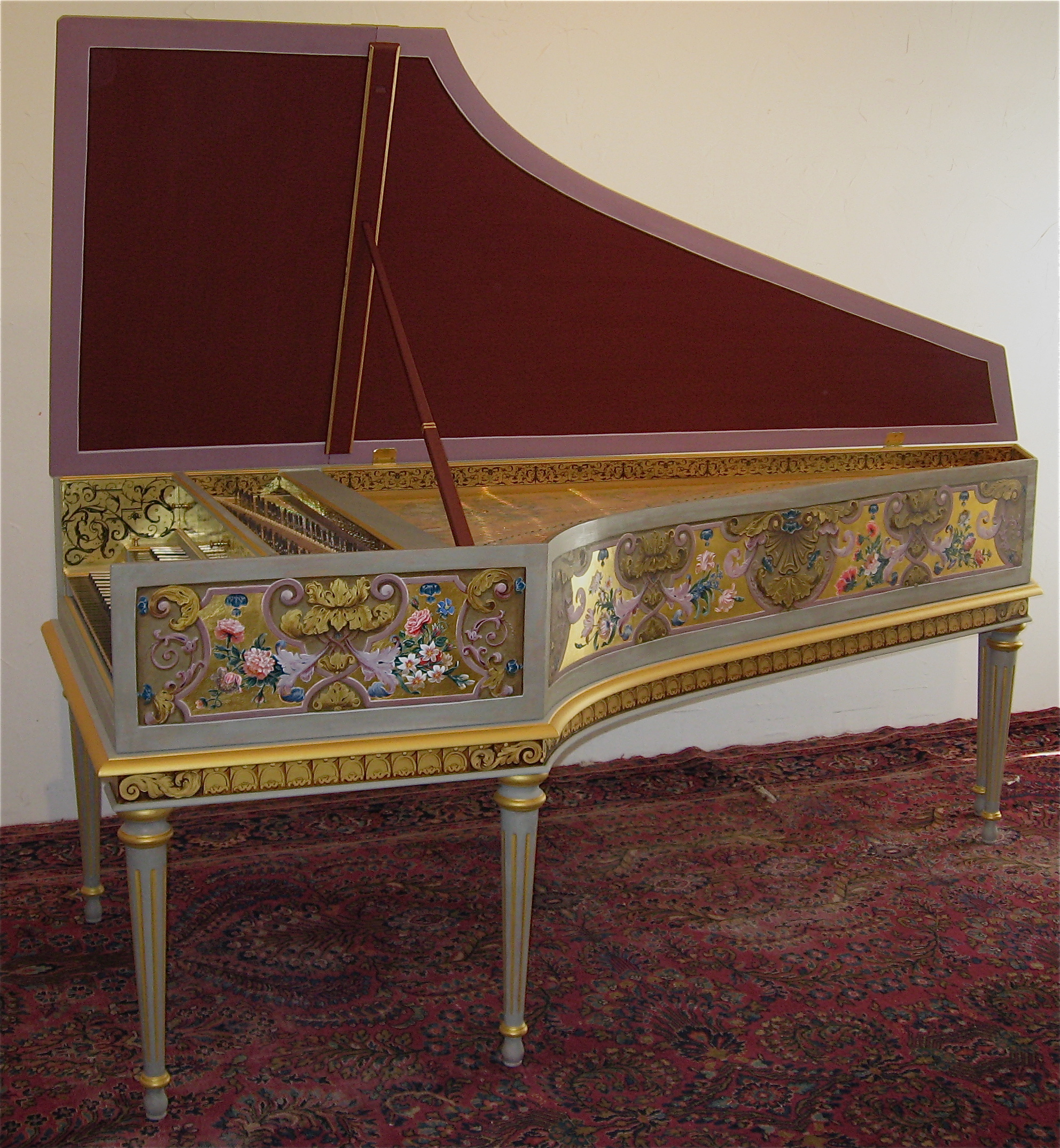
Jean-Philippe Rameau - Nouvelles Suites de Pièces de clavecin , Sarabande (1727) played by Jean Rondeau – harpsichord by K. Hill Opus 194, after the Ahaus Ruckers, made in 1984
.
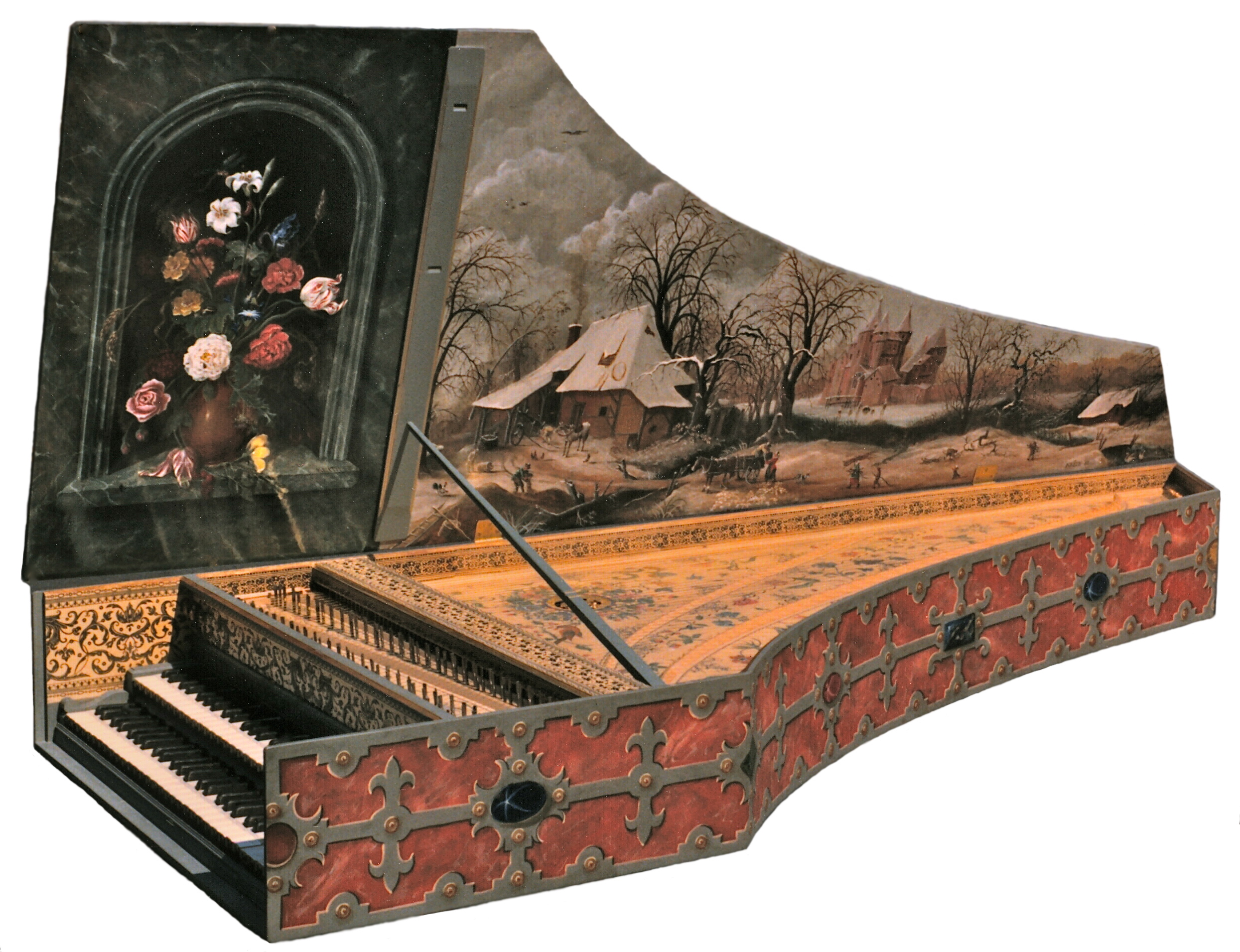
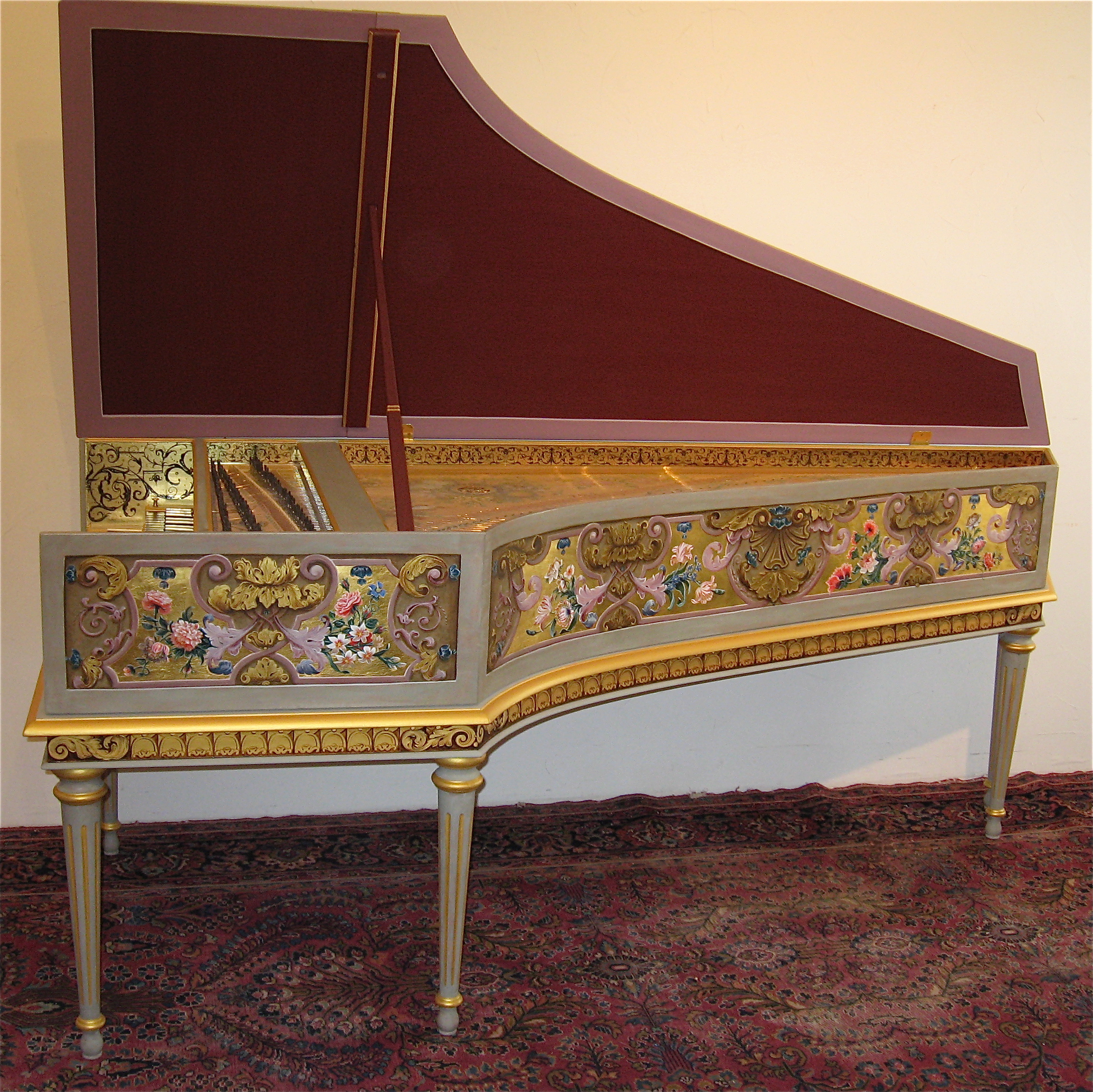
Harpsichord after Blanchet opus 398 belonging to Elizabeth Farr . This is one of my most favorite decorations both to do and to look at - It is based on the Couchet double in the Metropolitan Museum of Art in New York City. The recording below was made on this instrument.
Now you are able to view my "Opus List" by scrolling to the last entry on the ABOUT KEITH HILL page. Most of these harpsichords, clavichords, violins, guitars, and fortepianos continue to serve music as I intended them so to do when I made them. My chiefest aim has always been to build sounds that inspire a way of playing that deeply moves and excites listeners. This aim can be realized only by acoustical work of the highest quality. I define quality as anything that makes my instruments more like the antique instruments.
Here is a Sound Sample of one of my Taskin Harpsichords
MY AIMS
Now that I have achieved my personal goal of a reliable mastery over sound, I am able to produce the kind of sound I could only dream of 40 years ago. It is that skill and understanding that I am able to bring to each and every instrument I make. It is this skill and understanding which makes my instruments unique in our time. That is what I have to offer.
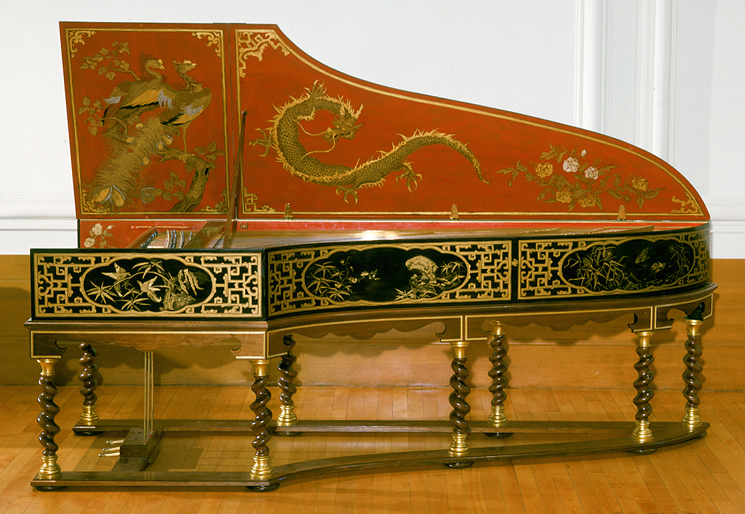
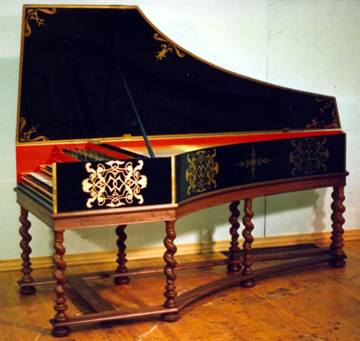
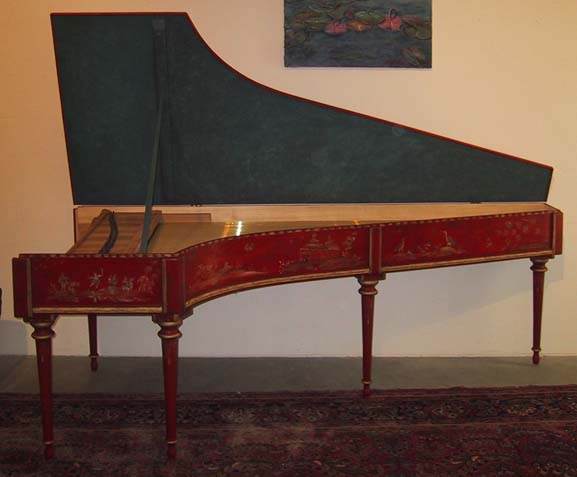
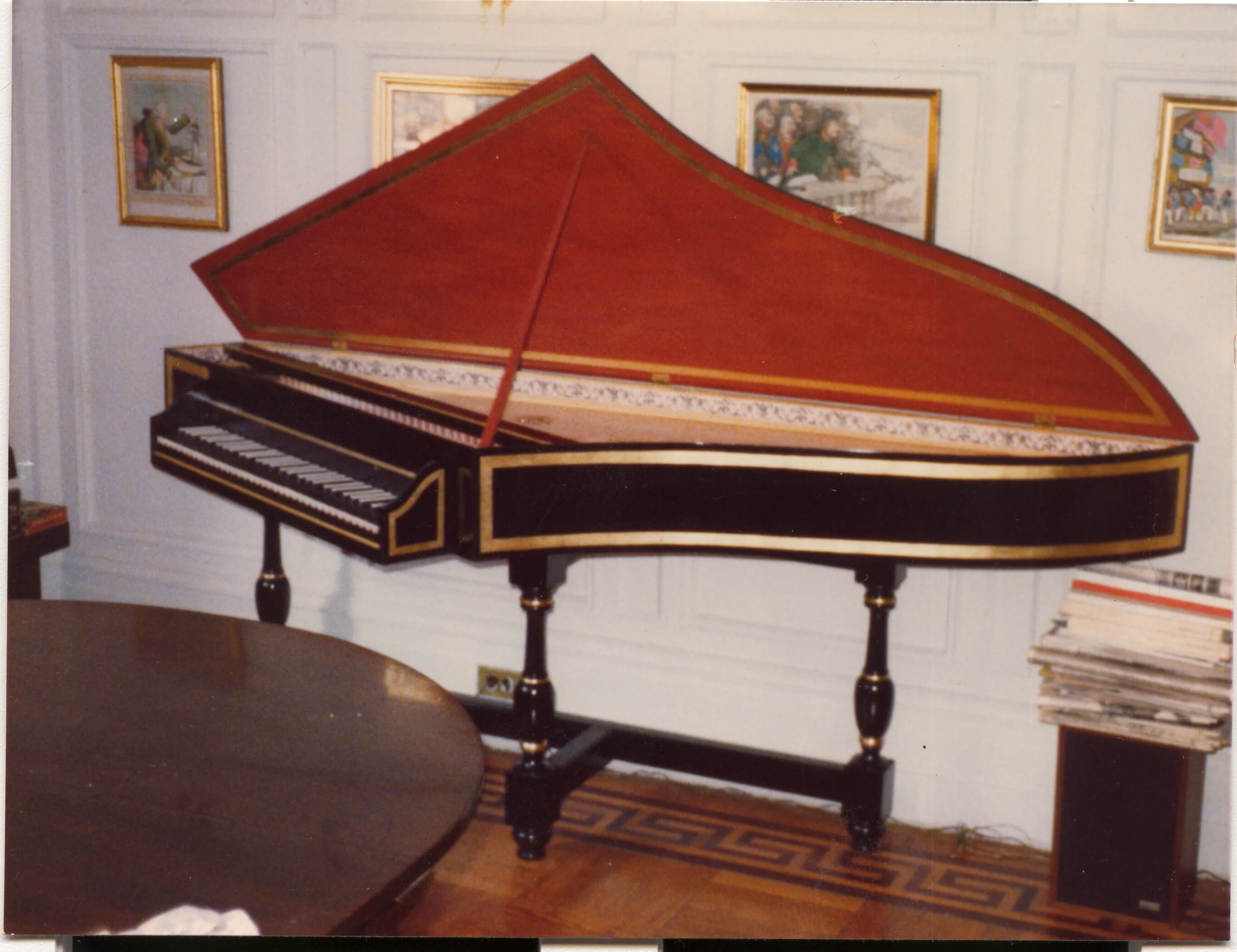
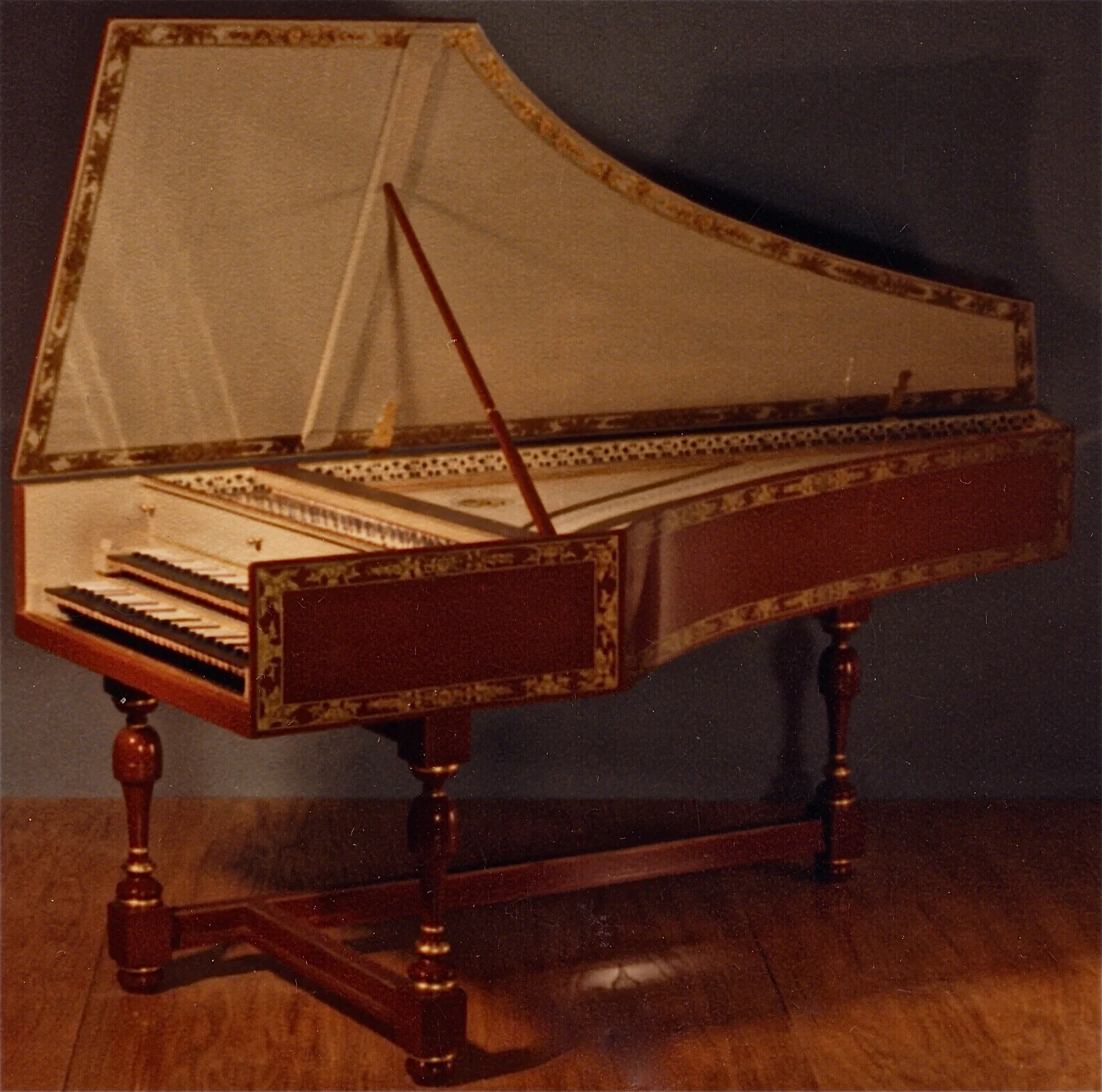
The photograph below is of a 1769 Taskin model harpsichord I built and decorated for myself in 2000, which recently sold to the University of Western Australia in Perth. The following performance is of my brother, Robert Hill, playing the first concert on that instrument in Perth.
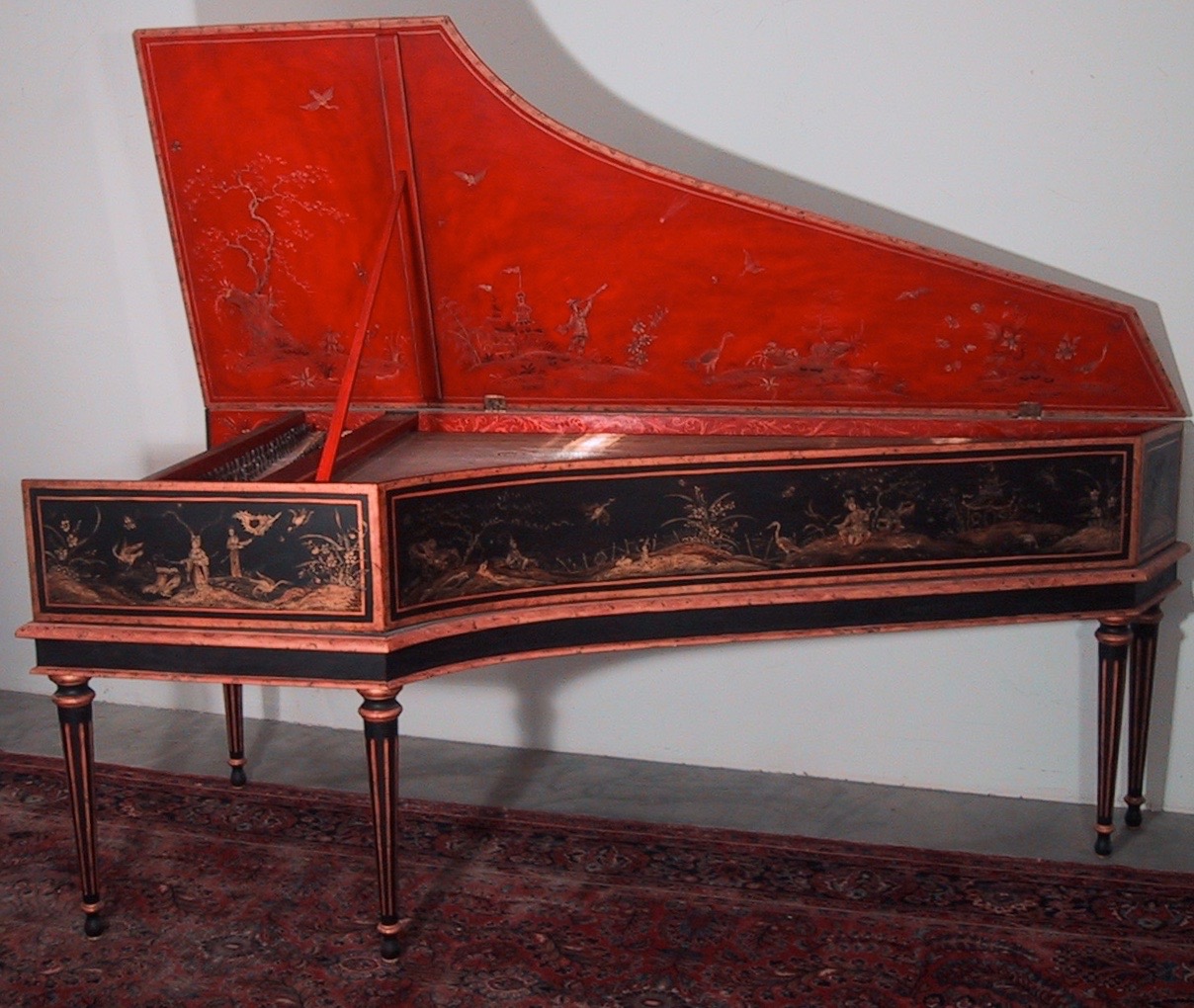
My chinoiserie on this harpsichord was inspired by seeing actual antique chinese decorated furniture . . . the result was both stunning and to my surprise made purposely dirty and mottled. I loved the effect because it makes the outcome so much more interesting. On the antique chinese furniture all what looked like real gold was actually a product made to imitate the appearance of gold by fusing mars yellow (iron oxide) on mica flakes. This harpsichord is now at the University of Western Australia in perth, australia.
Here is a Sound Sample Bach's Sarabande in d minor from Robert Hill’s transcription from the solo violin Partita.
The cardinal signs of a Hill instrument are: powerful tone, gorgeously vocal trebles, solid and resonant basses, beauty of tone color, intensely musical behavior of sound, flexibility of touch and color, and a singing and affectively "loaded" tone.
Here is a Sound Sample of Bach's Fugue from his solo concerto in a minor played by Elizabeth Farr on my most recent 16' Harpsichord.
The next Sound Sample is from CPE Bach's concerto for piano and harpsichord played on one of my Cristofori Pianos and one of my Taskin Harpsichords.
Why are these traits necessary? It is obvious that players and composers in the 18th century demanded instruments possessing these qualities to be made so that they would aesthetically support their musical conceptions and intentions. How do we know this? CPE Bach states explicitly in his Versuch to "Play from the Soul, not like a trained bird...endeavor to avoid everything mechanical and slavish". J.J.Quantz in his treatise, On Playing the Flute, explains to musicians that "musical execution may be compared with the delivery of an orator..." and that musicians and orators should aim "to make themselves masters of the hearts of their listeners, to arouse or still their passions, and to transport them now to this sentiment, now to that".
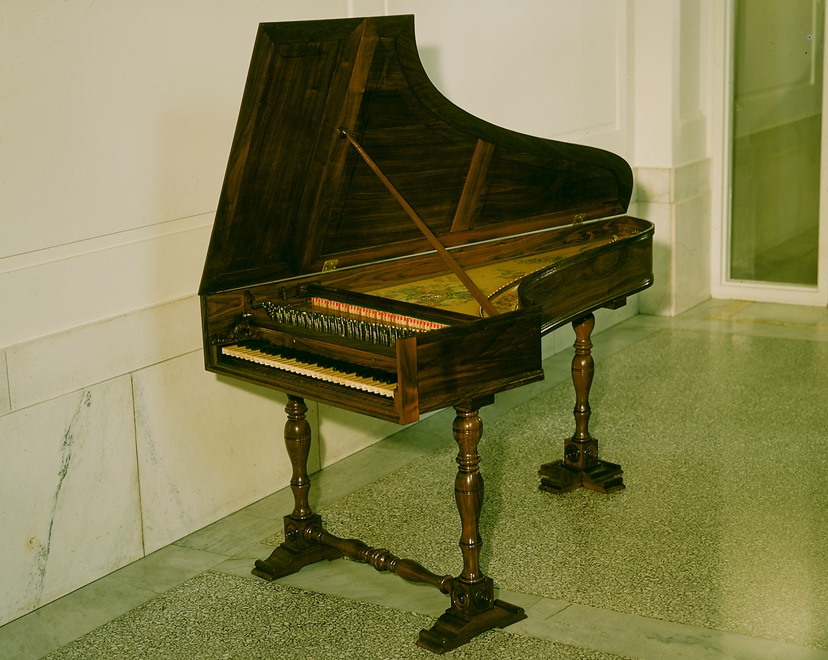
Pictured below are photos of the 1658 de Zentis harpsichord, which I restored in 2004 and which now resides in the “RESTORATION HOUSE” (built during the Restoration Period) in England, and of my most recent Italian Harpsichord- a copy of the de Zentis of 1658. Below the photos are sound samples, of the harpsichords pictured, played by Pamela Ruiter Feenstra, Martha Folts, and Elizabeth Farr, and Leonardo Garcia-Alarcon.


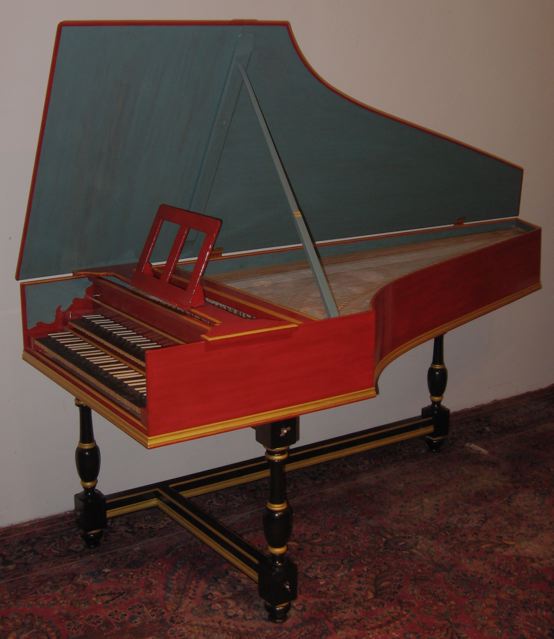
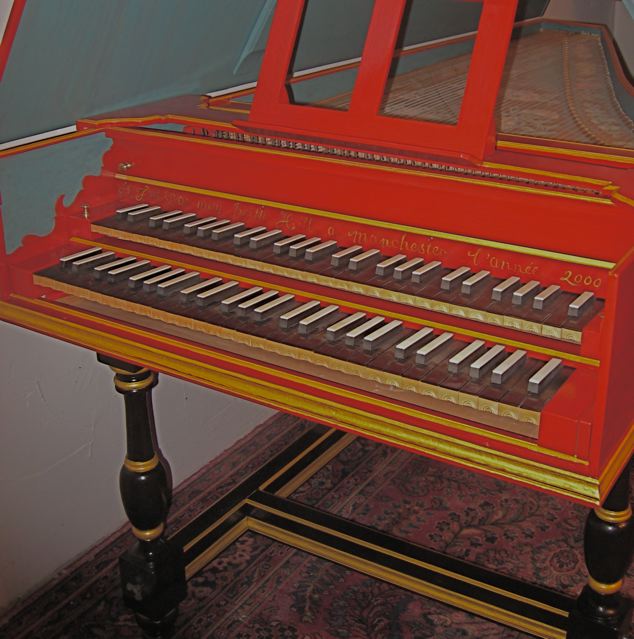
Italian Harpsichord after the G. de Zentis of 1658 made by Keith Hill Opus 407 in 2008
I understand that they meant these things literally, rather than hopefully. Therefore, I build my instruments with the sole aim of creating sounds which enhance and support (meaning: to make reasonable, logical, and beautiful) a highly expressive, highly flexible, highly affective, highly inflected, powerfully communicative, yet balanced style of playing. Playing that is, in a word, soulful.
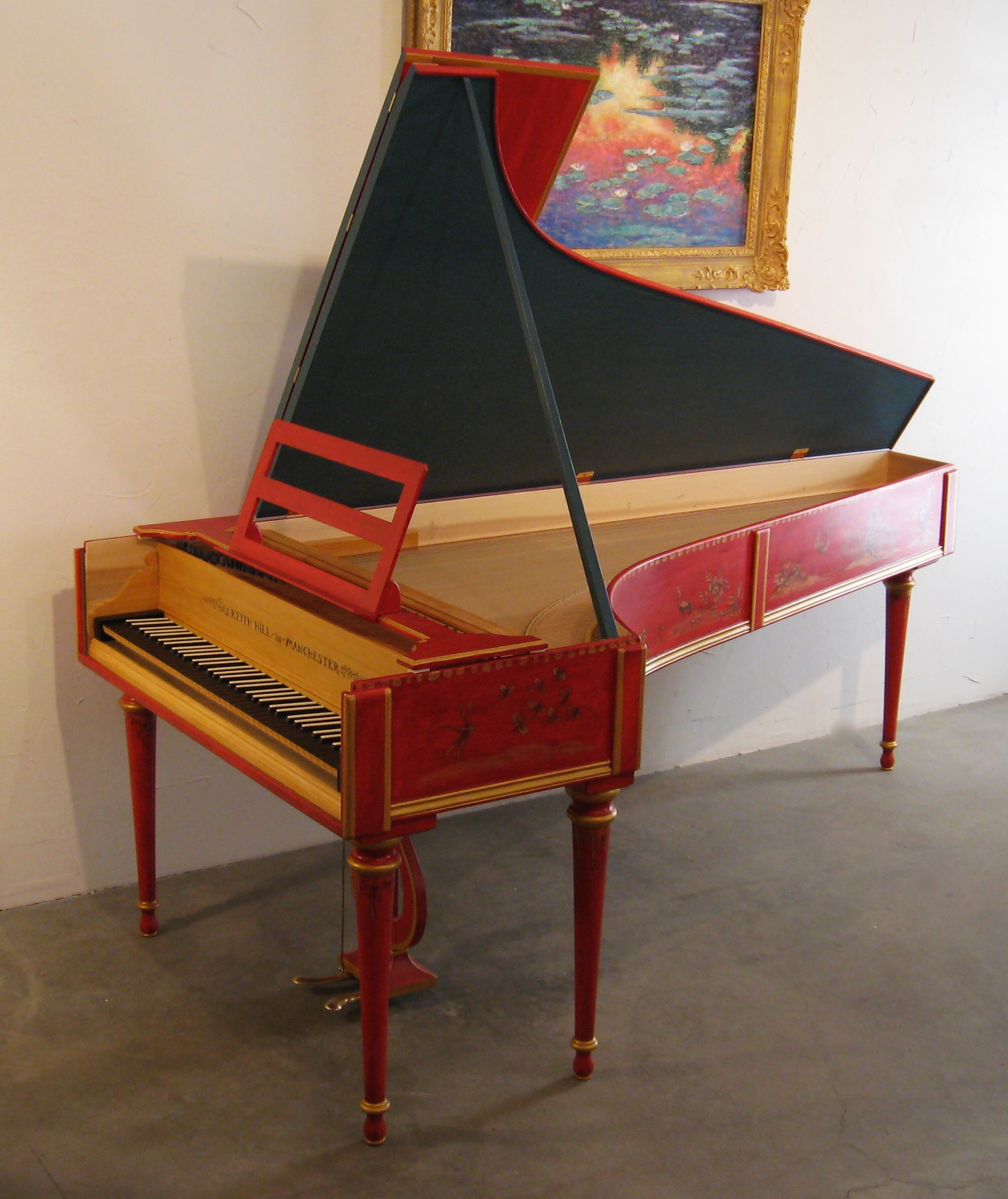
Until I built this 6 Octave Cristofori Fortepiano, no one had ever attempted to take Cristofori's design to its maximum limits. It is double strung in Brass. The two pedals work the Dampers and the Una chord keyboard shift. This piano is my Opus 363 made in 2003 and finally completed and sold in 2007 to the Technical University in Trondheim, Norway. The recordings below were made by Marianne Ploger on this piano just before it was shipped to Norway.
My goal now is to do everything in my power to encourage a return again to a sane, meaningful, highly expressive, masterful way of playing great music and creating great art. It is to this end that my instrument making is dedicated.
I have posted an article I wrote some years ago titled "The Art of Listening" in which I explain my understanding of the nature of what it means to listen...not merely hear. You can read this article by clicking on the ARTICLES button under the main heading of this page and selecting the specific page. I wrote "The Art of Listening" as a chapter in my "Treatise on the True Art of Musical Instrument Making" but was told that my view on the business of listening had no place in my Treatise, so I removed it even though I disagreed with the few readers who thought it best not to reveal how I listen. I hope you enjoy reading it and that it reveals something that will help you improve your own skill of listening.
ADVICE AND INFORMATION ABOUT
RECONDITIONING YOUR HILL HARPSICHORD
by Keith Hill ©2016 in Nashville
I have been in the business of making musical instruments for 44 years. If you own an antique or vintage HILL harpsichord and have not had the instrument renovated somewhat recently, that instrument is in sore need of being renovated with new strings, new quills, and new dampers. This sort of work needs to be done regularly about every 15 years depending on time and use.
I purposely assigned opus numbers to my instruments applying the label on the pinblock in the treble on most harpsichords and on the pinblock in the bass if there was no room in the treble. The reason first was to keep track of where my instruments were located and second to have a clear record of my development as an artist for my own use. In other words, if someone wrote to me and said they owned opus 34 and proceeded to describe something other that what my records indicated, I would tell them if their instrument was or was not genuine, as happened occasionally over the years. Third, and most importantly, was to demonstrate to those, who tend to attribute anything of high quality to one’s talent, just how wrong that is. I have had to work extremely hard to figure out all that I have come to understand about making a high quality sound, one that I personally consider worth listening to. Anyone who would think otherwise is wrong. And central to all that hard work is being attentive to intelligent criticism and figuring out how to use it. By this I mean not succumbing to the usual reaction to hearing criticism, which is, being offended. I consider the inability to hear, accept, and use criticism as the principle reason why most musical instrument makers make instruments that are not worth listening to. As one very fine violinist and critic of my violins recently told me, “You are one of the only violin makers I know who can actually accept and make use of criticism.” I responded by saying that I learned that lesson after having built my second harpsichord, that is, one can wallow in feeling offended or one can pay close attention to what is being said by the critic in order to improve the work. It is just a choice, nothing more.
To begin, here are some useful definitions of words used in this article to describe age or date of the instrument and especially the kind of work needed.
DEFINITIONS
ANTIQUE means older than 25 years. Any Hill harpsichord built before 1991 is an antique. If you own an antique Hill instrument and you have not had any significant work done on it since it was made, then your instrument is in serious need of being reconditioned.
VINTAGE means a particular period during which your Hill instrument was made. I delineate those periods according the degree of acoustical development and/or place or year in which your Hill instrument was made.
1972 – 1978 I began making harpsichords in Grand Rapids, Michigan. The instruments made between 1972 and 1978 are grouped in that ‘first’ period, a period during which I developed my acoustical thinking based of direct observations made of the acoustical behavior of my materials. The instruments made during this time are labeled: Opus 1 – 57
1979 – 1984 My second period includes, not only harpsichords, but also violins, clavichords and fortepianos. My instruments made during this time are labeled: Opus 58 – 194
1985 – 1995 My third period involved a move, in 1988, to Manchester, Michigan, and was when my acoustical thinking had developed enough for me to write up my results in a treatise that I titled: The True Art of Making Musical Instruments-the Forgotten Craft of Enhancing Sound. My instruments made during this time are labeled: Opus 195 – 306
1996 – 2003 My fourth period. This period was spent learning to use different ideas, further observations, and new information to increase my understanding of how the science of acoustic enhancement works. Instruments made during this time are labeled: Opus 307 – 374
2004 - the present. This period involved another move, in 2010, to Nashville, Tennessee. Opus 484 is my most recent instrument…a violin.
Those harpsichords from Opus 350 and before, depending on the conditions in which your Hill instrument has been kept, will likely be needing to be restrung, requilled and redampered, in a word…renovated, unless that has already been done earlier, that is, sometime within the previous 15 years.
RENOVATING - Means restringing because over time iron strings rust and brass strings corrode. Rust and corrosion act as an abrasive, which eats away at the tips of the quills causing the sound to become coarse and dull. This means the strings and the quills need to be replaced. Replacing all the quills with new quills often needs to be redone more regularly because over time many quills will have broken and were replaced by technicians who may or may not understand how to get the best sound from the instrument. Redampering is necessary if the damper cloth has been ‘eaten’ away by the strings.
RECONDITIONING - Whereas renovating involves only those aspects of set up that degrade through time and use, a reconditioning includes renovating and can but not necessarily involve any or all of the following, things which I recommend, i.e.: replacing plastic jacks with wooden jacks (which produces an improvement in tone of about 5-10%), changing all the cloths and felts in the instrument with a special material called woven-felt (which produces an improvement in tone of about 15%), acoustically adjusting/tuning the keyboards (which produces an improvement in tone of about 15%), acoustically adjusting/tuning the jacks (which produces an improvement in tone of about 5%), and when the strings are off the instrument, unpinning the bridges and tuning as well as acoustically adjusting the bridges (which produces an improvement in tone of about 5%).
REBUILDING - Usually involves replacing the soundboard, as well as everything done in a reconditioning. Since the soundboard has been removed, it also can involve acoustically adjusting the inside of the case and a re-engineering of the bracing system, should that prove acoustically beneficial.
UNDERSTANDING HOW TO ASSESS COST/BENEFIT RATIOS
To assess the quality of an instrument I rate every possible enhancement on a scale of one to 100. 1% assumes that the instrument is a competent piece of woodworking. 100% means that the maker has divined every possible means of enhancing the sound of an instrument and has applied all possible enhancements. I always use the finest, best sounding great antique instruments from the 17th or 18th centuries as my acoustical standard and call them “100%” instruments. Why? Because the ancient makers did everything in their power to enhance the sound of each instrument they made. The Colmar 1624 Ruckers is an 85% instrument only because the maker who converted the instrument from its original condition in order to upgrade the compass and specifications was not particularly astute about all possible enhancements of the things that got changed. The de Zentis that I restored in 2004, now in the Restoration House in England was a 100% instrument until the original 17th century Ivory key tops had to be removed due to customs requirements in order to ship it to Europe. The Grimaldi in Nüremberg, Germany is a 100% instrument. The Jan Couchet in Brussels, Belgium is also a 100% instrument. The Ahaus Ruckers used to be a 100% instrument before it was degraded in restoration to a 65% instrument as the soundboard was removed to flatten it. The 1769 Taskin was a 100% harpsichord when I first played it 45 years ago. Indeed, most well restored working antique harpsichords average between being a 55% - 85% instrument, because not all makers from the Baroque period had a complete knowledge of how to enhance every part of the instrument.
The old “serien” plucking piano type harpsichords commonly made in the 1930’s-70’s in Germany were only able to yield a 1-5% result. If the maker does everything any respectable furniture maker would do, by selecting the design and materials intelligently, the maximum result would be a 5-15% instrument. The best possible result most makers today can achieve, doing nothing to otherwise enhance the sound of the instrument beyond making a jot and tittle copy of a piece of furniture, yields about a 15-25% instrument.
For myself, I have always aimed to make 100% instruments, having figured that it is better to fall short of the mark than to not aim at all, yet also always assumed, no matter how good the sound might have been, its never good enough. So should you own an earlier Hill instrument and discover that my opinion of it may not be as high as yours, that is my artist’s prerogative. I see it as my job to have a skeptical ear, especially of my own instruments. Today, because I have done a few, a full rebuild of one of my earlier period instruments can yield a 65% - 80% result. A particularly good sounding example of my previous work can yield a 70% – 90% instrument.
COSTS
Each stage of reworking an instrument brings with it costs both for time and materials, and knowledge of how to create the best possible sound. The cost for renovating a double manual harpsichord is between $2100 - $4000, depending on the extent of the work and who does the work. A reconditioning of the same instrument costs between $5000 - $8,000. A complete rebuild costs between $15,000 - $22,000, depending on who does the work. This assumes no repair work needs to be done.
Anyone wishing to have their Hill harpsichord renovated, reconditioned or rebuilt in my shop should contact me through my email address: pictagoras48@gmail.com or call me on my cellphone after 2:30pm at 734-395-8708
LIST OF YOUTUBE VIDEOS WITH HILL INSTRUMENTS
Here are 130 + videos, that can be found of YouTube, in which my instruments are featured. I am sure that there are significantly more. That they do not appear in this list is probably because I have yet to either know about them of must accidentally discover them while browsing...not one of my favorite activities.
Bach BWV 829 Partita nr 5 in G major Benjamin Alard, harpsichord
https://youtu.be/l6G0xfKnTGk
J. S. BACH: BRANDENBURG CONCERTO 5 IN D MAJOR BWV 1050 played by the Croatian Baroque EnsembleHarpsichord by Keith Hill after 1769 Taskin Opus 414 in 2008
https://youtu.be/BnjqGhAlFzs
J.S. BACH: THE FRENCH SUITES (I) - Ignacio Prego, plays the Courante from French Suite no. 6 , BWV 817 Harpsichord by Keith Hill after 1769 Taskin Opus 360 in 2001
J.S. BACH: THE FRENCH SUITES (I) - Ignacio Prego, plays the Sarabande from French Suite no. 6 , BWV 817 Harpsichord by Keith Hill after 1769 Taskin Opus 360 in 2001
Jean-Philippe Rameau - Nouvelles Suites de Pièces de clavecin , La Sauvages (1727) played by Jean Rondeau – harpsichord by K. Hill Opus 194 after Ahaus Ruckers made in 1984
Jean-Philippe Rameau - Nouvelles Suites de Pièces de clavecin , Sarabande (1727) played by Jean Rondeau – harpsichord by K. Hill Opus 194 after Ahaus Ruckers made in 1984
J C F Fischer: Suite in D Minor 'Uranie', complete. Robert Hill, harpsichord by K. Hill 1988 after M. Mietke - strung completely in brass.
J. S. Bach 6-part Ricercar BWV 1079 Robert Hill, harpsichord
J S Bach: Capriccio BWV 992: Arioso Robert Hill, harpsichord
J S Bach: Partita in E Minor BWV 830: Toccata. Robert Hill, harpsichord
J S Bach: Partita in E Minor BWV 830: Sarabande. Robert Hill, harpsichord
J S Bach: Partita in C Minor BWV 826: Sarabande, Robert Hill, harpsichord
J S Bach: Partita in C Minor BWV 826: Sinfonia Robert Hill, harpsichord
J S Bach: Partita in E Minor BWV 830 Sarabande & Tempo di Gavotta, Mark Edwards, harpsichord
Jean Philippe Rameau (1683-1764): Nouvelles Suites de Pièces de Clavecin
Les Triolets- Mark Edwards, harpsichord by Keith Hill, built in Manchester, Michigan, 2010, after Blanchet
J S Bach Partita in B-flat Major BWV 825 Allemande Robert Hill harpsichord
J. S. Bach: Chromatische Fantasie und Fuge, BWV 903 - Fantasie - Robert Hill
J.S.Bach - Brandenburg Concerto No.5 in D BWV1050 - Croatian Baroque Ensemble
Robert Hill - Bach - Präludium and Fugue in A minor, BWV 894
Robert Hill - Bach - Suite in A minor, BWV 818a
Robert Hill - J.S. Bach - Toccata & Fugue in B minor BWV 923
J. S. Bach Fugue in A Major BWV 888 WTC II Robert Hill, harpisichord
Chambonnieres Pavan "L'Entretien des Dieux" Robert Hill, harpsichord
J.S. Bach - Sonata in e minor (1st mvt) with Cobus du Toit and Elizabeth Farr - Hill / Blanchet Opus 398 in 2005
J.S. Bach - Sonata in e minor (2nd mvt) with Cobus du Toit and Elizabeth Farr - Hill / Blanchet Opus 398 in 2005
J.S. Bach - Sonata in e minor (3rd mvt) with Cobus du Toit and Elizabeth Farr - Hill / Blanchet Opus 398 in 2005
Johann Sebastian Bach: Concerto for Keyboard Solo in G minor, (After Vivaldi RV 316), (BWV 975) Elizabeth Farr - Hill / Hass 16' Opus 361 in 2002
Johann Sebastian Bach: Concerto for Keyboard Solo in C major, (BWV 984) Elizabeth Farr - Hill / Hass 16' Opus 361 in 2002
Johann Sebastian Bach: Concerto for Keyboard Solo in C major, (BWV 977) Elizabeth Farr - Hill / Hass 16' Opus 361 in 2002
Johann Sebastian Bach: Concerto for Keyboard Solo in B flat major, (BWV 982) Elizabeth Farr - Hill / Hass 16' Opus 361 in 2002
Johann Sebastian Bach: Concerto for Keyboard Solo in B minor, (BWV 979) Elizabeth Farr - Hill / Hass 16' Opus 361 in 2002
Johann Sebastian Bach: Concerto for Keyboard Solo in C major, (After Vivaldi RV 265), (BWV 976) Elizabeth Farr - Hill / Hass 16' Opus 361 in 2002
Johann Sebastian Bach: Concerto for Keyboard Solo in G major, (After Vivaldi RV 381), (BWV 980) Elizabeth Farr - Hill / Hass 16' Opus 361 in 2002
Jacquet de La Guerre, Suite for Harpsichord III in A minor (1687) - I. Prelude Elizabeth Farr - Hill/Taskin made in 2004
Elisabeth-Claude Jacquet de la Guerre. Suite 1 D Minor : IV Coueante II- Elizabeth Farr - Hill/Taskin made in 2004
Elisabeth-Claude Jacquet de la Guerre. Suite 1 D Minor: I. Prelude- Elizabeth Farr - Hill/Taskin made in 2004
Elisabeth-Claude Jacquet de la Guerre. Suite 1 D Minor: II. Double - Elizabeth Farr - Hill/Taskin made in 2004
Claude Balbastre (1724-1799) 2 Sonatas in F major Elizabeth Farr
Jacquet de la Guerre: Gigue and Rondeau from the 6th suite. Elizabeth Farr - Hill/Taskin made in 2004
Johann Sebastian Bach: Concerto for Keyboard Solo in D minor, (BWV 987) Elizabeth Farr - Hill / Hass 16' Opus 361 in 2002
Johann Sebastian Bach: Concerto for Keyboard Solo in G major, (After Vivaldi RV 299), (BWV 973) Elizabeth Farr - Hill / Hass 16' Opus 361 in 2002
Toccata in A Minor by Johann Kaspar Kerll- Edward Parmentier Harpsichord
Chaconne L'Inconnue (13/14) "Livre de Suittes pour le clavecin" (attr. Louis Marchand) Mario Martinelli - Hill / Taskin Opus 381 2004
Allemande fait(e) pour Mme Deville (2/14) "Livre de Suiites pour le clavecin" (attr. Louis Marchand) Mario Martinelli - Hill / Taskin Opus 381 2004
Prélude par Renard (1/14) - "Livre des Suittes pour le clavecin" (attr. Louis Marchand) Mario Martinelli - Hill / Taskin Opus 381 2004
Badinage La Marinelle (10/14) "Livre de Suittes pour le clavecin" (attr. Louis Marchand) Mario Martinelli - Hill / Taskin Opus 381 2004
Louis-Claude Daquin (1694-1772) La Louisette "Recueil des Airs pour le clavecin" Mario Martinelli - Hill / Taskin Opus 381 2004
William Byrd's Pavana Lachrymae Italian harpsichord after the 1693 Anon. in the Smithsonian
Matthias Weckmann Toccata in D - Edward Parmentier Harpsichord After Johannes Ruckers 1640
W.A. Mozart (1756-1791) Allegro in F major KV 33B - Mario Martinelli - Hill / Zell Opus 354 made in 2000
Louis-Claude Daquin (1694-1772) Les Sirenes (anon.) "Recueil des Airs pour le clavecin" - Mario Martinelli - Hill / Taskin Opus 381 2004
William Byrd: Piper's Galliard (Rebecca Pechefsky) - Hill / Colmar Ruckers Opus 349 in 2000
W.A. Mozart (1756-1791) Variations on a Minuet by Fischer in C major KV 179- Mario Martinelli - Hill / Zell Opus 354 made in 2000
W.A. Mozart (1756-1791) Variations on "Dieu d'Amour" by Grétry in F major KV 352 / 374c- Mario Martinelli - Hill / Zell Opus 354 made in 2000
Tombeau pour Monsieur de la Forestiere (anon.) "Recueil des airs pour le clavecin" Mario Martinoli - Hill / Taskin Opus 381 2004
Gigue d'orgue La Saint-Honoré (7/14) "Livre de Suittes pour le clavecin" (attr. Louis Marchand) Mario Martinoli- Hill / Taskin Opus 381 2004
Prélude par Renard (1/14) - "Livre des Suittes pour le clavecin" (attr. Louis Marchand) - Hill / Taskin Opus 381 2004
Jean-Baptiste Forqueray (1699-1782) Allemande en mi mineur - Mario Martinoli - Hill / Taskin Opus 381 2004
Jean-Adam Guilain (attr.) (c. 1680 - c. 1740) La Ferrand "Recueil des Airs pour le clavecin" Mario martinoli- Hill / Taskin Opus 381 2004
Matinées baroques - Récital de violoncelle - Les Idées heureuses - G. Lagace - Hill / Ruckers Opus 194 1984
J.S. Bach - BWV 1080 - (19) Fuga a 2 claviere performed by Robert Hill, harpsichord and by Michael Behringer, harpsichord- Hill Italian harpsichords Opus Nos. 229 (1988) & 303 (1995)
Bach: Adagio Bb, Allemande A, Sarabande Em - Bradley Lehman Harpsichord and pedal harpsichord.
Domenico Scarlatti Sonata C Major K460 P. Masic - harpsichord after P. Taskin by Keith Hill (2010)
DuPhly Rondeau D Major Robert Hill, harpsichord
Johann Sebastian Bach, Goldberg-Variationen, 2. Variation - Gerhard Oppelt spielt am Cembalo nach Ruckers, gebaut 1999 von Keith Hill.
J. S. Bach Well-Tempered Clavier Book Two, Prelude and Fugue in C Minor - Robert Hill harpsichord by K. Hill after M. Mietke Opus 2361989
J S Bach: WTC I Prelude in C Minor BWV 847 Robert Hill, harpsichord by K. Hill after M. Mietke Opus 2361989
J S Bach: WTC I Fugue in C Minor BWV 847 Robert Hill, harpsichord by K. Hill after M. Mietke Opus 2361989
J S Bach: Partita in E Minor BWV 830, Corrente. Robert Hill, harpsichord
Georg Bohm Suite N 1 Mitzi Meyerson Harpsichord Clavecin
Georg Bohm Suite N 11 Meyerson Harpsichord
Georg Bohm Suite n 4 Meyerson Harpsichord
Georg Bohm Suite n 10 Meyerson Harpsichord
Georg Bohm Suite N 8 Meyerson Harpsichord
Georg Bohm Suite N 7 Meyerson Harpsichord
Georg Bohm Suite N 5 Meyerson Harpsichord
Georg Bohm Suite N 9 Meyerson Harpsichord
Georg Bohm Suite N 3 Meyerson Harpsichord
Georg Bohm Suite N 2 Meyerson Harpsichord
Georg Bohm Suite N 2 Meyerson Harpsichord Part 2
J. S. Bach - Toccata BWV 912 in D major- 2°JERMAINE SPROSSE - harpsichord Hill / Taskin Opus 317 1997.
J. S. Bach - Toccata BWV 912 in D major- 1° JERMAINE SPROSSE - harpsichord Hill / Taskin Opus 317 1997.
C. Ph. E. Bach - Sonata in a minor Wq 49/1 - 1° JERMAINE SPROSSE - harpsichord Hill / Taskin Opus 3171997.
C. Ph. E. Bach - Sonata in a minor Wq 49/1 - 2°JERMAINE SPROSSE - harpsichord Hill / Taskin Opus 3171997.
J. Ph. Rameau - Pieces de clavecin (1706) - 2°JERMAINE SPROSSE - harpsichord Hill / Taskin Opus 3171997.
J. Ph. Rameau - Pieces de clavecin (1706) - 1°JERMAINE SPROSSE - harpsichord Hill / Taskin Opus 3171997.
Jean Rondeau - Jean-Philippe Rameau - Nouvelles Suites de Pièces de clavecin (1727) – harpsichord by K. Hill Opus 194 after Ahaus Ruckers made in 1984
J S Bach: Chaconne BWV 1004. Robert Hill, harpsichord (live, c1992)
J S Bach French Suite in E Major BWV 817 live complete. Robert Hill, harpsichord
J S Bach: French Suite in C Minor BWV 813. complete. live. Robert Hill, harpsichord
J S Bach French Suite B minor BWV 814 complete. Live. Robert Hill, harpsichord
https://youtu.be/yelDKyl1r6E
J S Bach French Suite in G Major BWV 816 live complete. Robert Hill, harpsichord
P. Royer. La Marche des Scythes. Yago Mahúgo, Harpsichord.
https://youtu.be/GMPIMUuE7yI?list=RDrVq3mdPKSEw
J S Bach French Suite in E-flat Major BWV 815 live complete. Robert Hill, harpsichord
J S Bach French Suite D Minor BWV 812 complete. Robert Hill, harpsichord
J S Bach:Goldberg Variations complete (with indexing). Live. Robert Hill, harpsichord
Domenico Scarlatti Sonata in B Minor K. 87. Robert Hill, harpsichord
Domenico Scarlatti Sonata C Major K460 Pavao Masic Hill / Taskin Opus 414 2008
Domenico Scarlatti Sonata A Major K208 P. Masic ditto
Domenico Scarlatti Sonata D Major K492 P. Masic
D. Scarlatti: Sonata B Minor, K.87 P. Masic
J A Reincken Allemande C Major, Robert Hill clavichord
W. F. Bach Fantasia A Minor, Robert Hill fortepiano
J S Bach Adagio in C Minor BWV 1001 Robert Hill, harpsichord
W. F. Bach: Polonaise E Minor, Robert Hill, fortepiano after Cristofori by K. Hill 1999 Opus 342
J. S. Bach Violin Sonata in G Minor BWV 1001: Adagio, Robert Hill, lute-harpsichord
J. S. Bach Siciliano from Violin Sonata G Minor BWV 1001, Robert Hill, harpsichord
J S Bach: Partita in C Minor BWV 826: Sinfonia Robert Hill, harpsichord
DuPhly Rondeau D Major Robert Hill, harpsichord
DuPhly Rondeau D Minor Robert Hill, harpsichord
J. S. Bach: Sinfonia in g BWV 797, Robert Hill, fortepiano
J S Bach Chromatic Fantasy BWV 903, Robert Hill harpsichord
D. Scarlatti Sonata Pastorale Allegro K415, Robert Hill, harpsichord
G. F. Händel Suite in B-flat major:Prelude
W.A. Mozart (1756-1791) Variations on "Ah, vous dirai-je, Maman!" in C major KV 265 Mario Martinoli
J.S.Bach Prelude for clavesin in h minor BWV923 (Robert HILL).wmv
Beethoven "Moonlight" Sonata Op. 27 No 1: Adagio sostenuto. Robert Hill, fortepiano
Mozart KV 311 Andante con espressione Robert Hill, fortepiano
Mozart: Piano Sonata in B-flat, Robert Hill, fortepiano
F. A. Maichelbeck: Sonata Seconda (1736). Robert Hill, harpsichord (live, 1993)
Wilhelm Friedemann Bach - Concerto in E-flat major for 2 harpsichords
W.F. Bach - Concerto for 2 Harpsichords in E Flat - Mov. 1/3
C.P.E. Bach - Concerto for 2 Harpsichords in F - Mov. 1/3
J.S. Bach - BWV 912a - Toccata D-dur / D major - Robert Hill playing Hill / Taskin 1998
Bach - Brandenburg Concerto No. 5 in D major BWV 1050 Michael Behringer - Hill/Ruckers Opus 263 1992-3.
J.S. Bach - BWV 1080 - Contrapunctus 1- performed by Robert Hill, harpsichord Hill Italian Opus 229 1988
J.S. Bach - BWV 1080 - Contrapunctus 2
J.S. Bach - BWV 1080 - Contrapunctus 3
J.S. Bach - BWV 1080 - Contrapunctus 4
J.S. Bach - BWV 1080 - Contrapunctus 5
J.S. Bach - BWV 1080 - Contrapunctus 6 (in stilo francese)
J.S. Bach - BWV 1080 - Contrapunctus 7 (per augmentationem et diminutionem)
J.S. Bach - BWV 1080 - Contrapunctus 8
J.S. Bach - BWV 1080 - Contrapunctus 9 (alla duodecima)
J.S. Bach - BWV 1080 - Contrapunctus 10 (alla decima)
J.S. Bach - BWV 1080 - Contrapunctus 11
J.S. Bach - BWV 1080 - Contrapunctus 12,1 (in forma recta)
J.S. Bach - BWV 1080 - Contrapunctus 12,2 (in forma inversa)
J.S. Bach - BWV 1080 - Contrapunctus 13,1 (in forma recta)
J.S. Bach - BWV 1080 - Contrapunctus 13,2 (in forma inversa)
J.S. Bach - BWV 1080 - (14) Canon alla ottava
J.S. Bach - BWV 1080 - (15) Canon alla decima
J.S. Bach - BWV 1080 - (16) Canon alla duodecima
J.S. Bach - BWV 1080 - (17) Canon per augmentationem
J.S. Bach - BWV 1080 - (18) Fuga a 3 soggetti "B-A-C-H motif"
J.S. Bach - BWV 1080 - (19) Fuga a 2 claviere performed by Robert Hill, harpsichord and by Michael Behringer, harpsichord
J.S. Bach - BWV 1080 - (20) Alio modo: Fuga a 2 claviere performed by Robert Hill, harpsichord and by Michael Behringer, harpsichord
Bach Ricercar3.wmv played by Robert Hill on Hill / Cristofori fortepiano 2000
Johann Christian Bach Sonate A Major Opus 17 Nr.5 Robert Hill, fortepiano
F. W. Zachow Suite in B Minor, Robert Hill, lute-harpsichord
Bach Aria Variata BWV 989 lautenwerk basel 96.wmv
https://youtu.be/Wtv8_BBptlE?list=PLAB28C0781840418A
J S Bach Sinfonia E-flat Major BWV 791, Robert Hill clavichord
https://youtu.be/81fOeRek0I0
Christian Ritter Suite in F sharp Minor: Sarabande Robert Hill, Lautenwerk
https://youtu.be/dIjBh0eZRyY?list=PLAB28C0781840418A
Bach Prelude E flat BWV 998 lautenwerk basel 1996.wmv
https://youtu.be/Wej4lUxhjrA?list=PLAB28C0781840418A
Bach Aria Variata BWV 989 lautenwerk basel 96.wmv
https://youtu.be/vLfZxyUBPN0?list=PLAB28C0781840418A
Louis Couperin Prelude D Major Robert Hill, lute-harpsichord
https://youtu.be/AfNBqy5XWoI?list=PLAB28C0781840418A
Giles Farnaby Prelude in C, Robert Hill lute-harpsichord
https://youtu.be/iLHh3B7FEE4?list=PLAB28C0781840418A
C Ritter F# minor suite Allemande.wmv
https://youtu.be/MRpxeY2mp60?list=PLAB28C0781840418A
Bach chaconne clavichord 0610 1
J S Bach Largo from Violin Sonata C Major BWV 1005 Robert Hill on Hill / Hubert clavichord 2015
Forqueray Harpsichord Works,Mitzi Meyerson
https://youtu.be/ww7smoYLFcY?list=PLhxT191CSUvfWURHwf5wEFcDy2-EVrfNT
Matthias Weckman Works for Cembalo and Lute-Harpsichord,
Jan Katzschke - Hill Lute-harpsichord.
Peter Philips: Fantasia FVB I Nr. 88. Robert Hill, harpsichord by K. Hill Italian Opus 229 in 1988 after 1693 Anon. in Washington DC
Giovanni Pichi: Toccata FVB I/95. Robert Hill, harpsichordby K. Hill Italian Opus 229 in 1988 after 1693 Anon. in Washington DC
https://youtu.be/iVomvvI-NqQ?list=PLdFSlB2Q5NWN38VqkjnQ6ghvpkEKL-8dL
Thomas Morley: Fantasia (FVB II/124). Robert Hill, harpsichordby K. Hill Italian Opus 229 in 1988 after 1693 Anon. in Washington DC
https://youtu.be/OuYqMUfYA50?list=PLdFSlB2Q5NWN38VqkjnQ6ghvpkEKL-8dL
William Byrd: The Bells. FVB I/69. Robert Hill, harpsichord ditto
https://youtu.be/FT4TdQLpaDE?list=PLdFSlB2Q5NWN38VqkjnQ6ghvpkEKL-8dL
Elizabeth Rogers Virginal Book: March, Nightingale & Hornpipe. Robert Hill, harpsichord ditto
https://youtu.be/LMdHNNztExc?list=PLdFSlB2Q5NWN38VqkjnQ6ghvpkEKL-8dL
Fitzwilliam Virginal Book: Dances by various composers. Robert Hill, harpsichord ditto
https://youtu.be/hBdHDmybCYY?list=PLdFSlB2Q5NWN38VqkjnQ6ghvpkEKL-8dL
Giles Farnaby Intabulation Fantasy FVB II/ 236. Robert Hill, harpsichord ditto
https://youtu.be/I18SaPbxH0k?list=PLdFSlB2Q5NWN38VqkjnQ6ghvpkEKL-8dL
William Byrd: The Queene's Alman. FVB II/172. Robert Hill, harpsichord ditto
https://youtu.be/KOhjmjaXuT8?list=PLdFSlB2Q5NWN38VqkjnQ6ghvpkEKL-8dL
Peter Philips: Margott Laborez FVB I/83. Robert Hill, harpsichord ditto
https://youtu.be/NtOJOYADC_c?list=PLdFSlB2Q5NWN38VqkjnQ6ghvpkEKL-8dL
Galeazzo: Praeludium FVB I/99 in meantone tuning. Robert Hill, harpsichord ditto
https://youtu.be/xSVPn7XXSSY?list=PLdFSlB2Q5NWN38VqkjnQ6ghvpkEKL-8dL
John Bull: Praeludium in d FVB XLIII. Robert Hill, harpsichord ditto
https://youtu.be/cSVTggItK-M?list=PLdFSlB2Q5NWN38VqkjnQ6ghvpkEKL-8dL
Peter Philips: Fantasia FVB I Nr. 88. Robert Hill, harpsichord ditto
https://youtu.be/YnuVt2JjaZs?list=PLdFSlB2Q5NWN38VqkjnQ6ghvpkEKL-8dL
anonymous: Uppon La Mi Re. Robert Hill, harpsichord ditto
https://youtu.be/ZfG0OaLTp_g?list=PLdFSlB2Q5NWN38VqkjnQ6ghvpkEKL-8dL
John Bull: Trumpet Pavan. Robert Hill, harpsichord Hill / Taskin 1998
https://youtu.be/BEIihpHcrfM?list=PLdFSlB2Q5NWN38VqkjnQ6ghvpkEKL-8dL
Archangelo Corelli Sonata for Recorder and BC. Hill Italian Harpsichord from ca. 1986
PAGE REFERRALS
VIDEOS
Yevgeny Chepovetsky is a young violinist of the first order who is concerned about the mechanization of music making today. His writing is eloquent and very easy to understand given that he is a native of Riga in Latvia. Here is the link to his website:
www.yevgenychepovetsky.com
Yevgeny playing Bruch Violin Concerto
MATTHEW LAMMERS: Doctoral Lecture Recital
(Matt is my violin acoustics research partner. )
"Dialogue with Luthiers - Creating Precision, Progress, and Priorities"
using Keith Hill Violins Opus: 499, 509, 511, 531, 534, 535, 536
THE GREAT VIOLIN MYSTERY
The link below will take you to a Youtube video titled "The Great Violin Mystery" NOVA which aired in October of 1981
https://youtu.be/3A3_dmNs4Wg
The link below will take you to the page on my website where it can be viewed.
I have tried over many years to get the folks at NOVA to post or sell this video.